

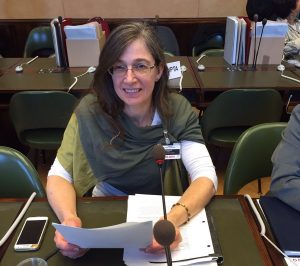
 On the 40th anniversary of Canada ratifying the International Covenant on Economic, Social and Cultural Rights and the International Covenant on Civil and Political Rights, CWP presented to the Standing Committee on Justice and Human Rights. CWP’s presentation focused on the future of the Court Challenges Program of Canada (CCPC) and access to justice for people living in poverty. The presentation provided an overview of the entrenched stigma associated with living in poverty that is often internalized and can result in a fear of reprisal or further prejudice, particularly when individuals try to claim their legal rights, and the way in which the CCPC can be used as a mechanism for Canada to realize its human rights obligations.
 As part of the Dignity for All campaign, CWP presented the All Party Anti Poverty Caucus with thousands of postcards collected from across Canada that call for a national anti-poverty plan. The Caucus, composed of Conservative, Liberal, and New Democratic parliamentarians, presented the postcards to then Prime Minister Harper. The postcards were gathered as part of the International Day for the Eradication of Poverty (October 17) in collaboration with 45 communities from coast to coast and CWP’s partner in the Dignity for All campaign, Citizens for Public Justice. The postcards were signed as part of an activity known as ChewonThis! which raises awareness about food insecurity and poverty in Canada.
CWP continues to work with and present to the All Party Anti Poverty Caucus to this day.
